1. Introduction: The High Cost of Doing Business as Usual
For decades, the construction industry has accepted a grim reality: large-scale projects run an average of 20% over schedule. Traditional management tools, such as the Critical Path Method (CPM) and manual oversight, are increasingly inadequate for the dynamic, fast-paced environment of the modern job site. These legacy systems are reactive by design, identifying problems only after they have impacted the budget. We are now entering a pivot point—Construction 4.0—where Artificial Intelligence (AI) and Digital Twins are no longer just industry buzzwords. They are the practical foundation for shifting project management from “experience-based manual production” to a future of “data-driven automation.”
2. From 8 Hours to 2: The End of Planning Paralysis
The administrative burden of project planning has long been a bottleneck, but new software ecosystems are proving that administrative drag is optional. Tools like BIMpro and aheadAPS (the hub platform bridging CAD, ERP, and MES) are slashing the time required to move from design to production.
A notable example of this transformation is found at Taracon Precast. By implementing integrated planning software, the firm reduced its data import and planning duration from eight hours to just two. This 75% reduction in planning time allows teams to adapt to project changes in real-time, providing a massive competitive advantage.
“The efficiency and economy brought to our precast layout by the Progress Group software not only saved considerable costs over the project’s lifespan but enabled us to keep projects on track and be able to adapt to changes effectively.” — Paul Nelson, Vice President of Taracon Precast
3. Predictive Analytics: Seeing the Delay Before It Happens
AI-powered delay forecasting shifts the project manager’s role from “firefighter” to “strategist.” By utilizing Predictive Analytics, AI models analyze vast datasets to identify risk patterns before they escalate. These models are trained on specific historical and real-time inputs, including:
- Historical project timelines and labor productivity records.
- Real-time weather patterns and supply chain logs.
- Equipment usage and predictive maintenance data.
Through Schedule Risk Analysis and Scenario Simulations, AI can raise “red flags” about potential slippage before it occurs. This allows managers to explore “what-if” cases and re-optimize resources to avoid trade clashes and the domino effect of delays.
Quick Summary: AI in construction uses predictive analytics, real-time project data, and machine learning to forecast delays before they occur. By identifying risk patterns early, AI tools help project managers make informed decisions and optimize construction schedules.
4. The “Aware” Construction Site: Digital Twins and Smart Objects
The next evolution of the job site involves Smart Construction Objects (SCOs). These are traditional resources—labor, machinery, and materials—transformed into intelligent assets through IoT integration. SCOs possess three defining attributes:
- Awareness: The capability to sense and record real-time conditions.
- Communicativeness: The ability to transmit information and event alerts (via Wi-Fi, Bluetooth, etc.).
- Autonomy: The ability to act independently based on preset rules and reasoning algorithms.
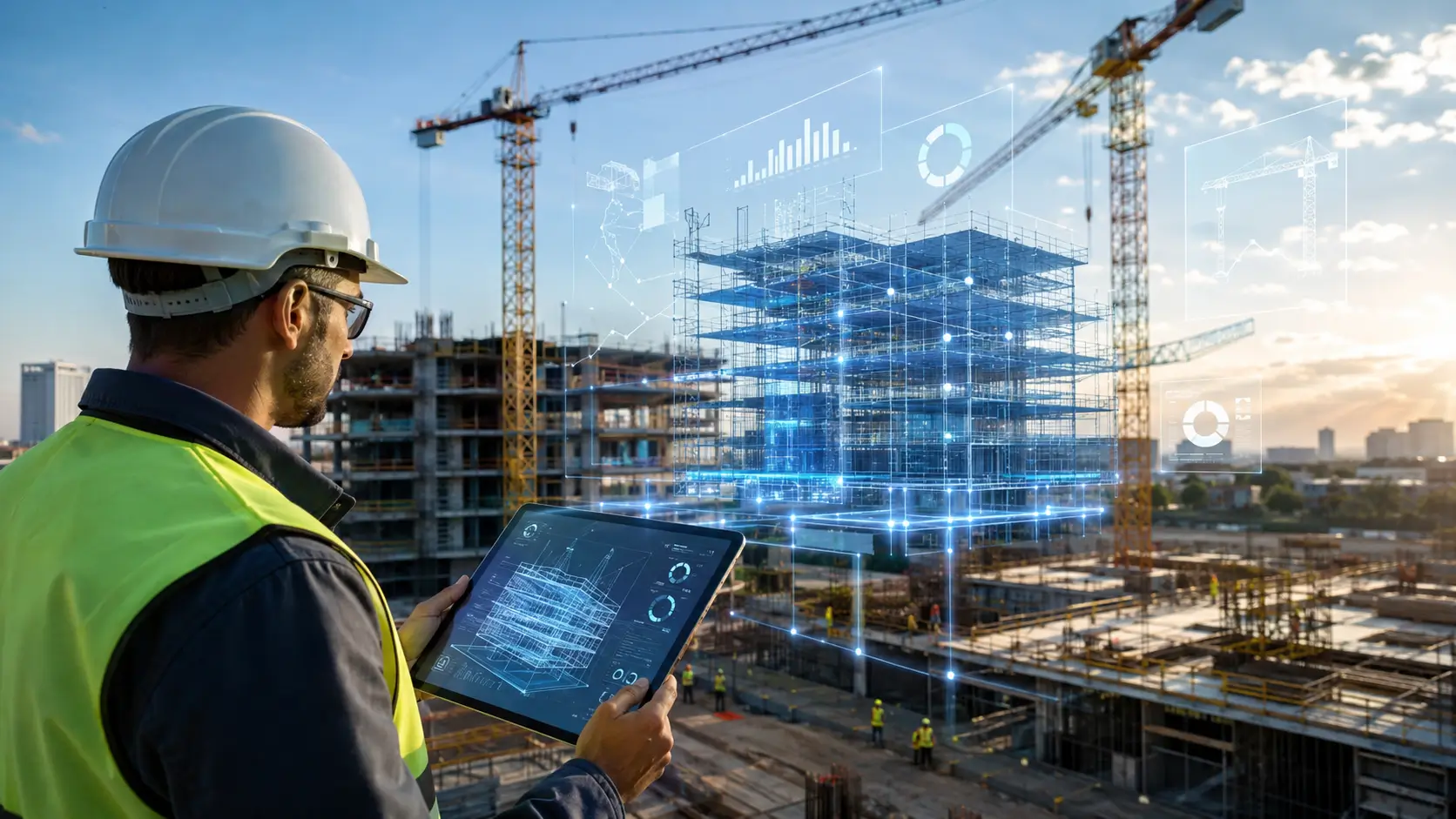
When these SCOs are integrated into a 5D Digital Twin, they create a bidirectional communication flow between the physical and digital worlds, providing the real-time data inputs required for high-level optimization.
| Feature | Traditional Monitoring | Digital Twin Monitoring |
| Data Collection | Manual, fragmented, and slow | Real-time, automated IoT inputs |
| Visibility | Isolated 2D/3D models | Visualized 5D status tracking |
| Traceability | Human-dependent records | Fully traceable, digital event logs |
| Interactivity | Fragmented/One-way | Bidirectional (Physical-Digital Sync) |
5. Concrete with a Memory: AI-Driven Mix and Quality Control
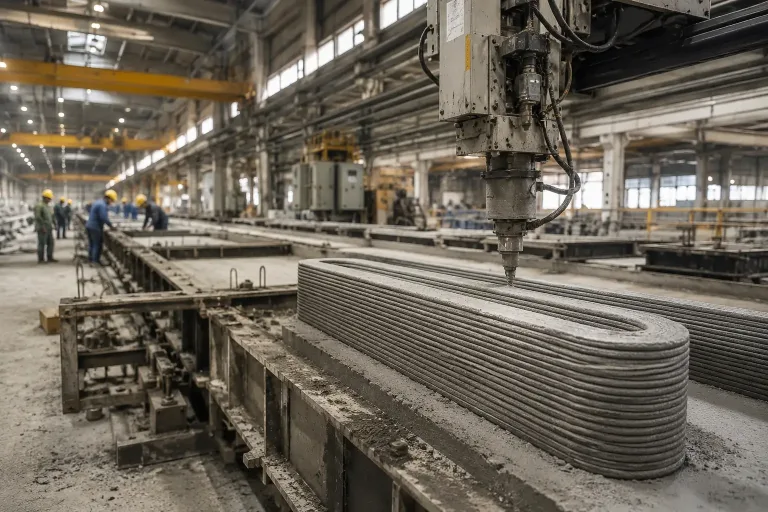
AI is also revolutionizing material science. On the factory floor, AI algorithms analyze material properties and historical test results to suggest adjustments to cement content, maintaining target strength while reducing costs. Furthermore, Curing Control systems now use AI to monitor temperature and humidity inside curing chambers in real-time, adjusting conditions to ensure consistent material properties and reduced energy waste.
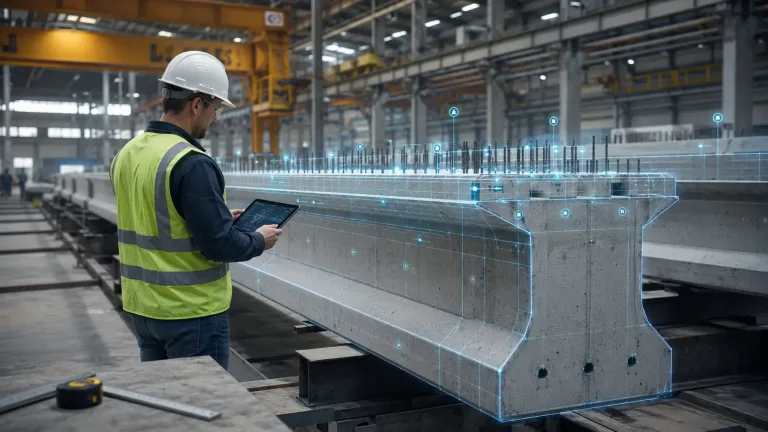
For quality control, computer vision systems like Buildots utilize helmet-mounted 360° cameras to scan the site, detecting surface voids, spalling, and dimensional deviations from the CAD model. These digital records provide a level of consistency that human inspectors simply cannot match, ensuring every element is checked against the original design.
6. Bridging the Digital-Physical Divide with RFID
One of the most persistent causes of delay is the “misplacement” of components. In Prefabricated Prefinished Volumetric Construction (PPVC) projects, the mean installation delay—the gap between planned production and actual installation—can reach a staggering 280 days.
To mitigate this, industry leaders are moving beyond simple ID mapping. The technical “magic” lies in the data mapping between Industry Foundation Classes (IFC) and ProgressXML (PXML). By mapping IFC unique IDs to physical RFID tags through this PXML bridge, firms achieve “semantic enrichment.” This makes the data readable for prefabrication machines and ensures that materials are tracked from the factory gate to the final assembly location, eliminating “double handling” and erroneous installations.
7. Dynamic Scheduling: Self-Adapting to the Unexpected
In the “Industry 4.0” model, a single disruption no longer renders a project schedule obsolete. Dynamic Scheduling uses the Digital Twin as a virtual aggregation level powered by the Asset Administration Shell (AAS).
When a disruption occurs (like a late delivery), the system utilizes Simulation-based Schedulers (such as the Sim4BFT framework) and Genetic Algorithms (GA) to minimize “total order tardiness.” Because the SCOs provide the “Awareness” needed to see the disruption, the system can automatically re-optimize the production sequence. This moves the industry toward a state of self-controlled, autonomous production.
“All in all, I think Progress Group is the only company we could have partnered with due to their shared vision of the future and how they can incorporate work instructions into machine data files to eliminate human error along the way.” — Alan Cartwright, Taracon Precast’s TQM Director
8. Conclusion: The Blueprint for a Resilient Future
The path forward is clear, yet the hurdles of data quality and legacy system integration remain. However, as the construction industry transitions from reactive management to data-driven automation, these tools are becoming essential for survival. We can no longer afford the fragmentation of the past.
The tools to end the “Age of Delays” are already in production. The only remaining question is strategic: can the industry afford to continue building with 17th-century methods in a 21st-century digital economy?