1. Introduction: The Death of the Tape Measure
We are witnessing the death of the tape measure—and it’s about time. For too long, the precast plant operated in a state of “best-guess” engineering, where manual approximations led to expensive site-day reworks. The inert, “dumb” concrete slab of the 20th century is finally being replaced by high-tech, living systems.
Today’s concrete components are no longer static blocks of stone and steel; they are data-rich assets mirrored in real-time. This shift represents a funeral for the outdated mindset of “close enough.” We are entering an era where construction behaves more like aerospace manufacturing than a traditional job site.
2. Achieving Sub-Millimeter Accuracy with Computer Vision
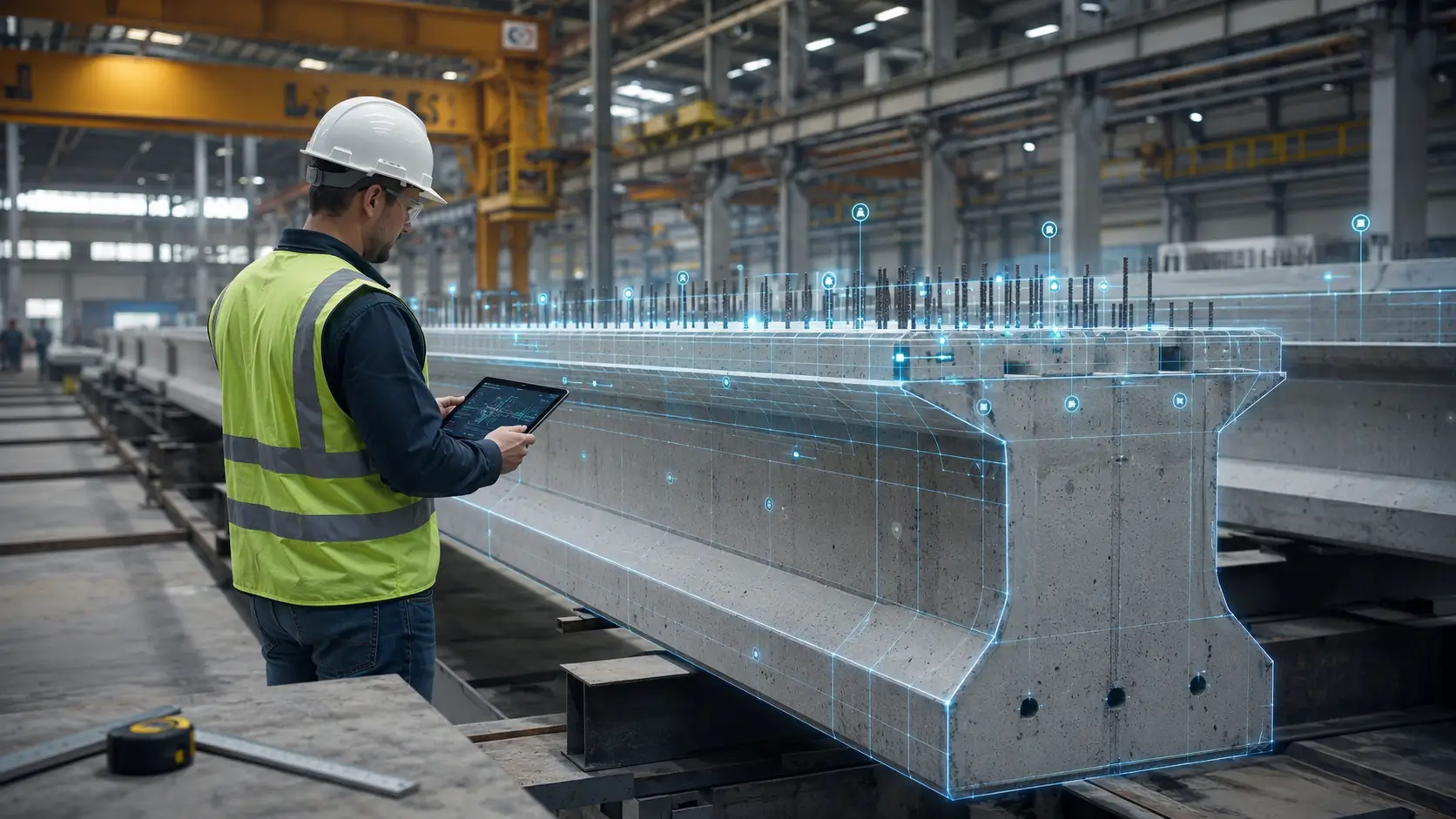
The “digital eye” of AI-driven vision systems has rendered manual inspection obsolete. These systems achieve a staggering average accuracy of 1 millimeter by comparing real-time dimensions against cloud-based CAD and BIM files. Any geometric deviation is flagged instantly, ensuring that every component fits perfectly before it ever reaches the crane.
Beyond surface geometry, we are now using AI-enhanced X-ray and ultrasonic pulse velocity (UPV) to “see” through the pours. This non-destructive testing (NDT) identifies internal voids and density variations that would otherwise remain hidden. Catching a structural void in the plant doesn’t just improve quality; it prevents a catastrophic structural liability shift on the actual job site.
Vision systems with AI ensure accurate dimensional verification by comparing real-time precast elements dimensions to a CAD file that’s taken from a cloud database and automatically detects geometric errors and deviations.
3. The “Digital Twin” and the End of the Curing Guessing Game
Digital twins have ended the era of “curing by hope.” By embedding thermal and stress-strain sensors directly into the concrete, manufacturers feed real-time data into a virtual replica. We no longer wait for a calendar date to strip molds; we wait for the twin to confirm the exact moment the design compressive strength is reached.
The strategic impact of this technology is undeniable. Implementing digital twins can yield a 10% reduction in project duration and a 40% cut in long-term maintenance costs. Furthermore, industry data shows a staggering 50% reduction in downtime and a 30% improvement in labor efficiency.
4. Inventory Management Without the Paperwork
Inventory management has historically been a zero-sum game of excess versus shortage. By using computer vision and particle swarm optimization, we can now precisely identify the types and quantities of components in the yard. This automated tracking replaces the clipboard with a real-time “Yard Orchestration” system.
This isn’t just about finding a slab; it’s about achieving true Just-In-Time (JIT) delivery. By connecting ordering, RFID tracking, and transportation through AI, we ensure construction progress never stalls due to missing parts. The result is a seamless flow from the production hall to the final structural position.
5. The “Fear of Surveillance” – The Human Cost of Automation
As we flood sites with sensors, we trigger a “chilling effect” identified in recent AEC ethics reviews. Workers often feel a sense of mistrust, feeling judged by a robotic collaborator that never tires and never looks away. This constant monitoring goes beyond safety; it creates a genuine risk to the psychological health of the crew.
While AI makes sites safer by detecting PPE violations, it raises significant concerns regarding informed consent and data privacy. We must balance the drive for 24/7 efficiency with the emotional well-being of the human workforce. The site of the future must be built on trust, not just on total visibility.
Performance monitoring refers to surveillance concerns in the workplace, also known as the chilling effect. Workers might feel they are being watched by collaborative robots and being evaluated on their work performance.
6. Generative Design and the “Optimal” Crane
In the past, designers drew solutions; today, they curate outcomes. Using tools like Dynamo and Refinery, we have moved from parametric design to true design optimization. The human expert defines the Goals and Evaluators, while the algorithm acts as the Generator, testing thousands of permutations to find the mathematically perfect setup.
This is most evident in complex logistical puzzles like tower crane positioning. Algorithms can simulate every hoist and supply zone scenario to avoid conflicts and eliminate hoisting bottlenecks before they happen. This shift allows practitioners to focus on high-level value while the machine handles the grueling iterative work.
7. The “Exclusive” Business Edge (IP Ownership)
Owning your AI is the only way to escape the “subscription tax” of off-the-shelf software. A sovereign tech stack ensures that your proprietary production data isn’t just making a vendor’s product better—it’s building your own exclusive Intellectual Property. This custom approach allows for scaling across multiple production halls without recurring license fees.
By securing IP transfer agreements for source code and design documentation, manufacturers gain a massive competitive advantage. They are no longer locked into a single vendor’s roadmap or price hikes. In the Industry 4.0 landscape, the manufacturer who owns the code owns the future of the factory.
8. Conclusion: Beyond the Controlled Environment
The industry is rapidly pivoting toward “Trustworthy AI,” where reliability and transparency are the new benchmarks for success. While these systems currently thrive in the controlled environment of the plant, their expansion to the dynamic job site is inevitable. This transition requires more than just better sensors; it requires a new way of thinking about liability.
We must establish a robust Responsibility Framework to guide this evolution. As these systems become more autonomous, we have to decide where the buck stops when the virtual and physical worlds clash. As AI takes on more decision-making power, will the ultimate liability rest with the designer, the programmer, or the system itself?