1. Introduction: The “Invisible” Revolution in Stone
Concrete is the bedrock of civilization, yet the industry often operates on a logic that hasn’t shifted significantly since the 1600s. We’ve stayed stuck in “craft-era” thinking—treating every pour like a bespoke art project rather than a precision manufacturing process. This resistance to change is exactly why margins are bleeding into the factory dust. However, beneath the surface of gantry cranes and formwork, an invisible revolution is occurring. By shifting from grit to data, forward-thinking precasters are proving that the world’s oldest industry can become its most technologically advanced. The following insights reveal how digital twins, additive manufacturing, and lean principles are finally plugging the leaks in the balance sheet.
2. Beyond the Mold: 3D Printing’s Design Freedom
In traditional precast, the mold—or formwork—is the primary cost driver and the greatest enemy of architectural freedom. Historically, complex shapes required labor-intensive, custom timber or steel molds that were often scrapped after a single project.
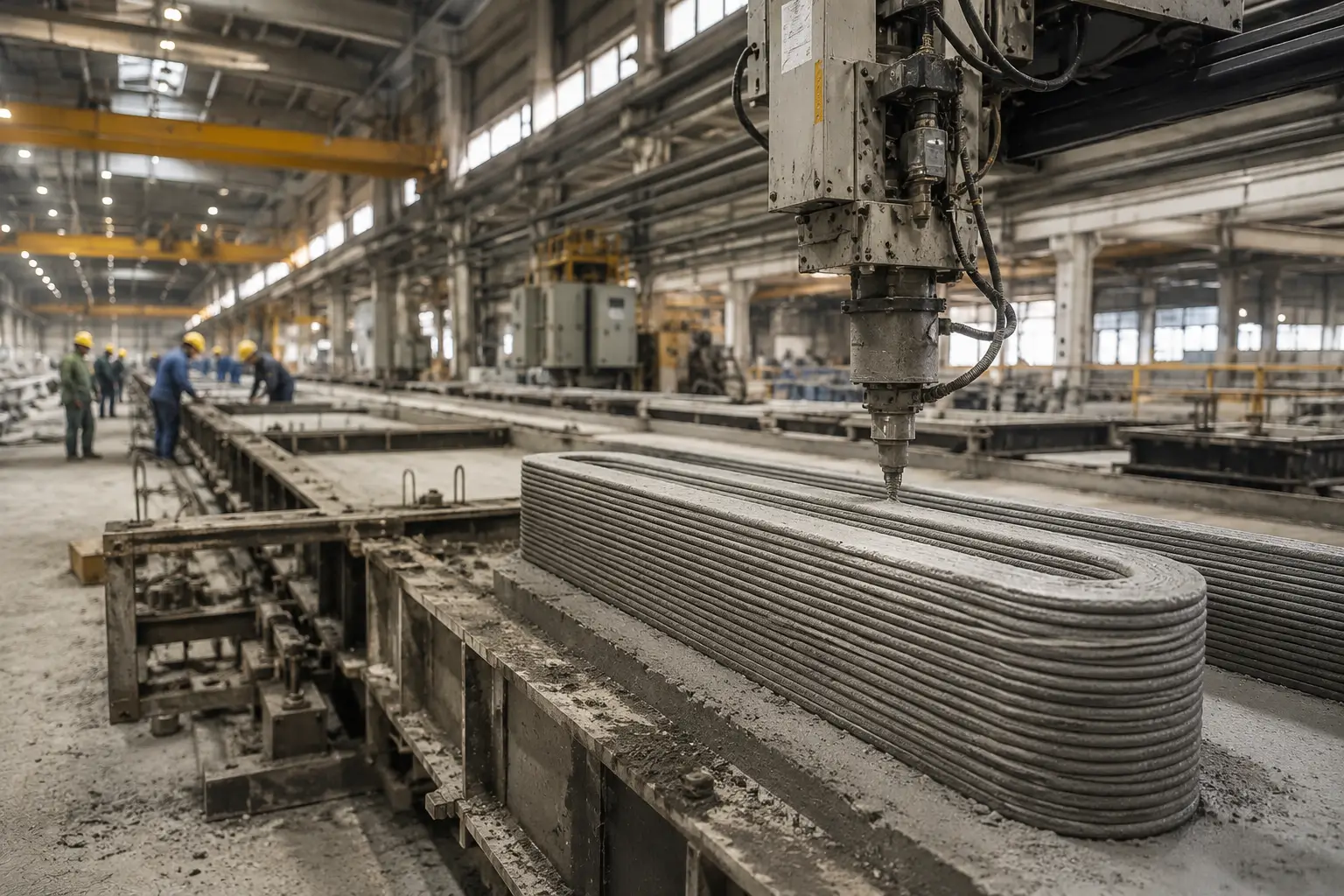
The strategy is shifting. Large-format 3D printers are now used to create precise, reusable molds directly from digital files. In some high-spec applications, we are even seeing concrete printed in layers, eliminating formwork entirely. This isn’t just about aesthetics; it’s about material efficiency. By optimizing concrete mixes and reducing cement consumption, additive manufacturing offers a sustainable path that lowers both the carbon footprint and material waste.
“By combining the scalability of precast with the precision of additive manufacturing, the industry is taking concrete innovation to the next level—one layer at a time.”
3. The “Living” Component: Digital Twins and Real-Time Intelligence
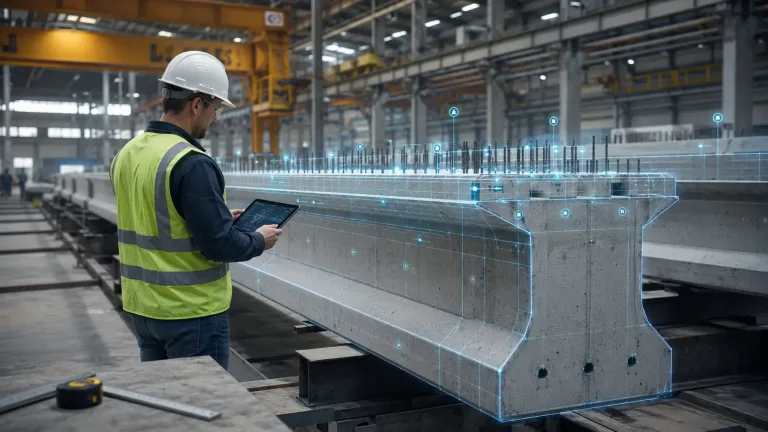
“Digital Twin” is often dismissed as a buzzword, but in a modern plant, it is the virtual counterpart that makes physical elements—like sandwich wall panels—intelligent. By embedding sensors and utilizing RFID or UWB (Ultra-Wideband) tracking, we can monitor curing curves, thermal performance, and structural integrity in real time.
This technology allows us to simulate R-values and finish customizations before a single drop of concrete hits the bed. More importantly, AI-driven inspection within the twin framework allows for:
- Predictive Quality: AI vision identifies dimensional deviations or misplaced embeds instantly. If a defect is caught in the casting bed, it prevents the 10x cost escalation (the “Rule of 10”) that occurs once the piece reaches the yard.
- Accelerated Production: Real-time sensor data determines exactly when a panel reaches design compressive strength, allowing for faster stripping of the beds and reduced energy use.
- Operational Transparency: Tracking every pallet and component reduces downtime by 50% and improves labor efficiency by 30%.
Strategic Impact: These gains translate to a 10% reduction in project duration and a 40% cut in long-term maintenance costs.
4. The Eleven-Mile Walk: Uncovering Hidden Lean Waste
Waste in a precast plant is rarely found in the trash bin; it’s found in the “Motion” of the crew. We often pay workers to move, not to produce. At one facility, operations managers placed pedometers on personnel working at a long-line casting bed. The data revealed that workers were walking as many as 11 miles (18 km) per day.
Time studies show that plant personnel are typically paid for one to two hours every day just for walking—searching for tools, looking for drawings, or navigating poor plant layouts. This “walking waste” is a symptom of poor workplace organization and represents a massive hidden cost. In a lean operation, tools sit in fixed locations, and information flows to the worker, ensuring that every movement adds value to the element.
5. The “Rule of 10”: The High Price of Rework
Quality control in precast is governed by a brutal exponential: The “Rule of 10.” It costs ten times more to fix a nonconforming component in the yard than it does in the casting bed. If that piece makes it to the job site, the cost can jump another tenfold.
Many plants maintain a “hospital” area—a dedicated zone for repairing defective elements. To a Smart Construction Strategist, a “hospital” isn’t a facility; it’s a symptom of a failed process. Sending a piece to the yard with known defects, hoping to “fix it later,” is a margin-killer. Preventative systems—integrated with the Digital Twin’s AI inspection—are the only way to ensure that “done” actually means “done.”
“It costs 10 times as much to fix a piece in the yard as it does in the bed.”
6. Cracking the Curing Bottleneck: A 26% Efficiency Gain
In high-volume plants, the curing area is almost always the “dominant constraint.” When the beds are full, the entire plant stops. A simulation study of a Canadian panel plant analyzed how to break this bottleneck. The study compared doubling physical bed capacity (Scenario A) against implementing steam curing to accelerate strength gain (Scenario B).
| Scenario | Strategy | Cycle Time Reduction | Impact / ROI |
| Scenario A | Doubling Curing Beds | 26% | 78% ROI; Payback in < 7 months |
| Scenario B | Steam Curing | 24% | Accelerated strength gain; 5% lower bed utilization |
While Scenario A required a higher capital outlay (CAD 180,000), it generated an annual net benefit of CAD 320,000 by removing system-wide congestion. Relieving the curing bottleneck is often the single most effective way to improve yard dwell time and gantry crane utilization.
7. Conclusion: The JIT Future of Construction 4.0
The industry is moving toward a Just-in-Time (JIT) model where factory production is perfectly synchronized with site readiness. To manage the chaos of weather and logistics, we now use Monte Carlo simulations. By running 10,000 iterations of a project schedule, we can move beyond “best guesses” to probabilistic reality—such as identifying an 80% probability of project completion within 21 days.
This data-driven approach allows for a 20% reduction in inventory and a 15% reduction in project delivery times. The competitive reality of Construction 4.0 is here. The question for plant owners is simple: Are you still applying craft-era logic to a manufacturing world, or are you ready to turn your operational grit into digital gold?